📖 Kernbegrippe & Teorie
📖 Key Concepts & Theory
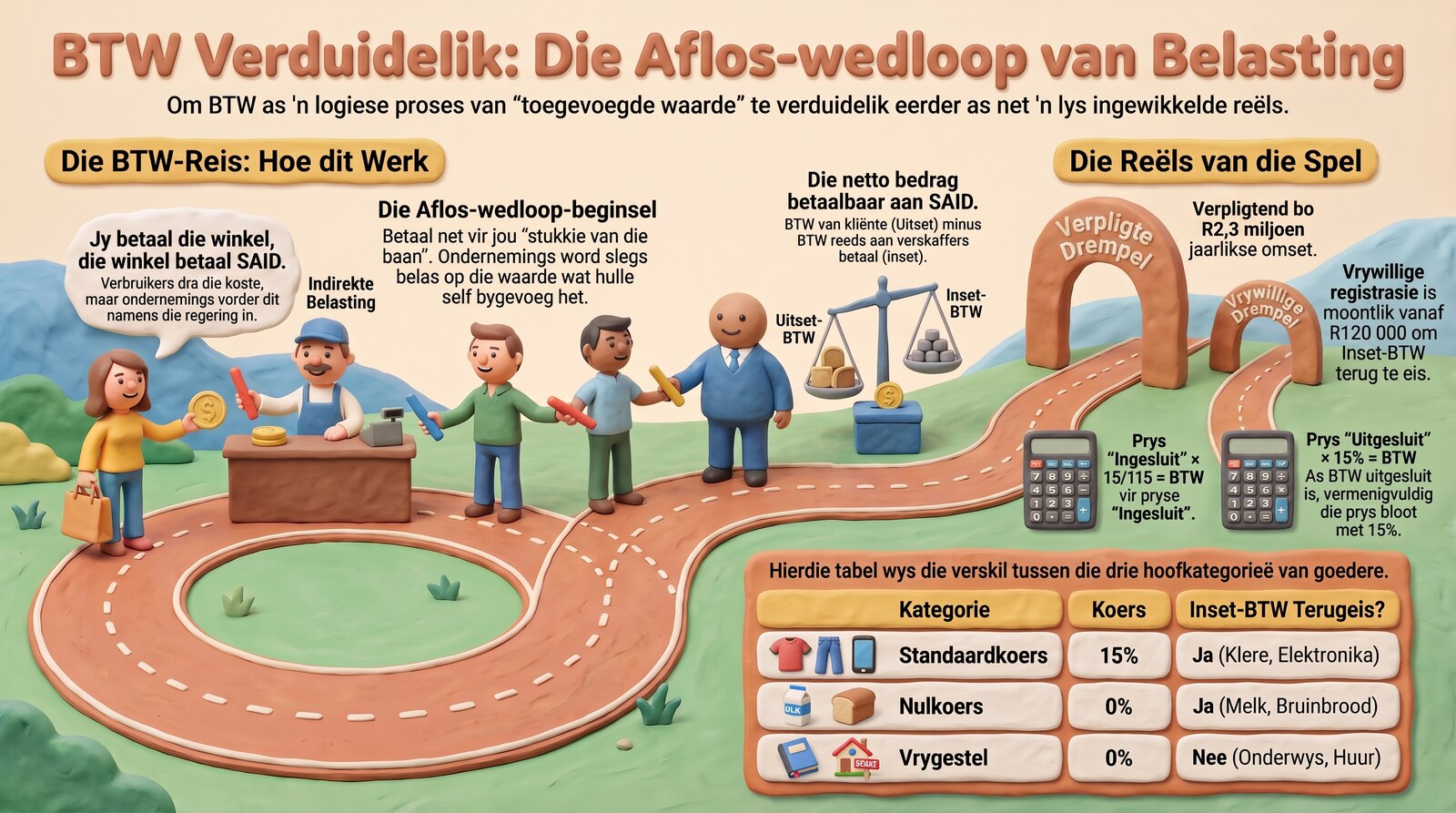
BTW is die onderwerp waaroor die meeste Graad 10-leerders struikel — nie omdat die wiskunde moeilik is nie, maar omdat dit gewoonlik as 'n lys reëls aangeleer word. Hierdie opsomming vertel dit eerder as 'n storie: wat gebeur werklik met die geld tussen die oomblik wat 'n boom gekap word, en die oomblik wat 'n gesin 'n nuwe stoel by die huis aflewer?
Direkte belasting teenoor indirekte belasting
Direkte belasting word reguit van 'n persoon of maatskappy se inkomste afgetrek (bv. LBS wat van 'n salaris afgetrek word) — die persoon wat verdien, betaal direk aan SAID.
Indirekte belasting word by die prys van goedere en dienste bygevoeg. Die verbruiker betaal nooit SAID direk nie — 'n onderneming vorder die belasting namens SAID in en betaal dit oor.
Wanneer jy 'n item koop, betaal jy die winkel. Dit is die winkel — nie jy nie — wat wetlik verantwoordelik is om daardie BTW aan SAID te oorhandig. Jy het nooit enige direkte kontak met SAID nie.
Dink aan 'n aflos-wedloop met verskeie lopers. Elke loper hardloop net sy EIE gedeelte van die baan — nie die hele wedloop van voor af nie. 'n Produk beweeg op 'n soortgelyke manier: van rou materiaal, na vervaardiger, na winkel, na jou huis. Elke onderneming (elke "loper") betaal net BTW oor die stukkie wat HY self bygedra het — nooit oor die hele wedloop weer nie.
✅ Die Goue Reël
- Geen onderneming in die ketting word ooit belas op waarde wat 'n VORIGE onderneming reeds verantwoord het nie.
- Elke onderneming betaal SAID net vir die stukkie baan wat hy self gehardloop het.
- Niemand betaal twee keer vir dieselfde stukkie waarde nie.
| Term | Betekenis | Rigting |
|---|---|---|
| Uitset-BTW | Die BTW wat 'n onderneming van sy EIE kliënte hef wanneer dit iets verkoop | Geld wat INkom |
| Inset-BTW | Die BTW wat die onderneming self aan sy EIE verskaffers betaal wanneer dit iets koop | Geld wat reeds UITbetaal is |
As Uitset-BTW GROTER is as Inset-BTW, betaal die onderneming die verskil aan SAID (die gewone geval). As Inset-BTW GROTER is (bv. na groot toerustingaankope), betaal SAID die verskil aan die onderneming TERUG.
| Kategorie | BTW-koers | Inset-BTW terugeisbaar? | Voorbeelde |
|---|---|---|---|
| Standaardkoers | 15% | Ja | Klere, elektronika, meubels, restaurantetes |
| Nulkoers | 0% | Ja | Bruinbrood, mieliemeel, melk, groente, eiers |
| Vrygestel | Geen BTW gehef nie | Nee | Skoolgeld, residensiële huur, sekere openbare vervoer |
Vir 'n koper lyk BEIDE asof hulle "geen BTW" dra nie. Maar agter die skerms is hulle heeltemal verskillend: 'n nulkoers-verkoper hef steeds BTW (net teen 0%) en bly BINNE die BTW-stelsel — dit KAN Inset-BTW terugeis. 'n Vrygestelde verskaffer staan HEELTEMAL buite die stelsel — dit hef geen BTW nie, MAAR kan OOK NIE enige Inset-BTW terugeis nie; dit dra self die koste.
| Metode | Wanneer gebruik | Formule |
|---|---|---|
| Metode 1 | Prys sluit BTW IN | BTW = Prys (ingesluit) × 15/115 |
| Metode 2 | Albei pryse (voor en na BTW) gegee | BTW = Prys (ingesluit) − Prys (uitgesluit) |
| Metode 3 | Prys sluit BTW UIT | BTW = Prys (uitgesluit) × 15% |
"Ingesluit" in 'n vraag → gebruik die ÷115-roete of trek af. "Uitgesluit" in 'n vraag → vermenigvuldig met 15%. Die woorde "ingesluit" en "uitgesluit" is nie versiering nie — hulle vertel jou presies watter metode om te gebruik.
| Jaarlikse omset | Registrasiestatus |
|---|---|
| Meer as R2,3 miljoen | Verpligte registrasie — moet binne 21 besigheidsdae registreer |
| Tussen R120 000 en R2,3 miljoen | Vrywillige registrasie — die onderneming kan self kies |
| Minder as R120 000 | Mag glad nie as 'n BTW-verkoper registreer nie |
Hierdie drempels het skerp gestyg vanaf 1 April 2026: die verpligte drempel het van R1 miljoen na R2,3 miljoen gestyg, en die vrywillige drempel het van R50 000 na R120 000 gestyg — die eerste verandering in 17 jaar. 'n Onderneming registreer deur 'n VAT101-vorm te voltooi, en dien gewoonlik elke twee maande 'n BTW-opgawe in.
Belastingvermyding (Wettig)
Om jou sake, BINNE die reëls, so te reël dat jy nie meer belasting as nodig betaal nie — bv. deur 'n groot aankoop noukeurig te tydsbereken, of wettige aftrekkings te gebruik.
Belastingontduiking (Onwettig)
Om doelbewus inkomste weg te steek, verkope te onderverklaar, te weier om te registreer wanneer wetlik vereis, of rekords te vervals. 'n Kriminele oortreding met moontlike swaar boetes, terugwerkende belastingrekenings, en gevangenisstraf.
Karoo Meubels se stoel beweeg deur drie BTW-geregistreerde ondernemings voordat dit by Mev. Botha, die finale kliënt, uitkom. Let op hoe BTW Betaalbaar by elke stap presies gelyk is aan 15% van die waarde wat daardie onderneming self bygevoeg het.
| Onderneming | Koop teen (excl.) | Verkoop teen (excl.) | Uitset-BTW | Inset-BTW | BTW Betaalbaar |
|---|---|---|---|---|---|
| Boland Bosbou | R0 (kap self) | R200,00 | R30,00 | R0,00 | R30,00 |
| Karoo Meubels | R200,00 | R500,00 | R75,00 | R30,00 | R45,00 |
| Huis & Tuin Meubelwinkel | R500,00 | R700,00 | R105,00 | R75,00 | R30,00 |
✅ Die Insig wat hierdie Tabel Bewys
- Mev. Botha betaal R700,00 + R105,00 BTW = R805,00 in totaal.
- Tel die "BTW Betaalbaar"-kolom op: R30,00 + R45,00 + R30,00 = R105,00 — presies dieselfde as die Uitset-BTW wat by die laaste stap gehef is.
- SAID vorder dieselfde totale bedrag in, ongeag hoe — BTW versprei net die invordering oor elke onderneming in die ketting.
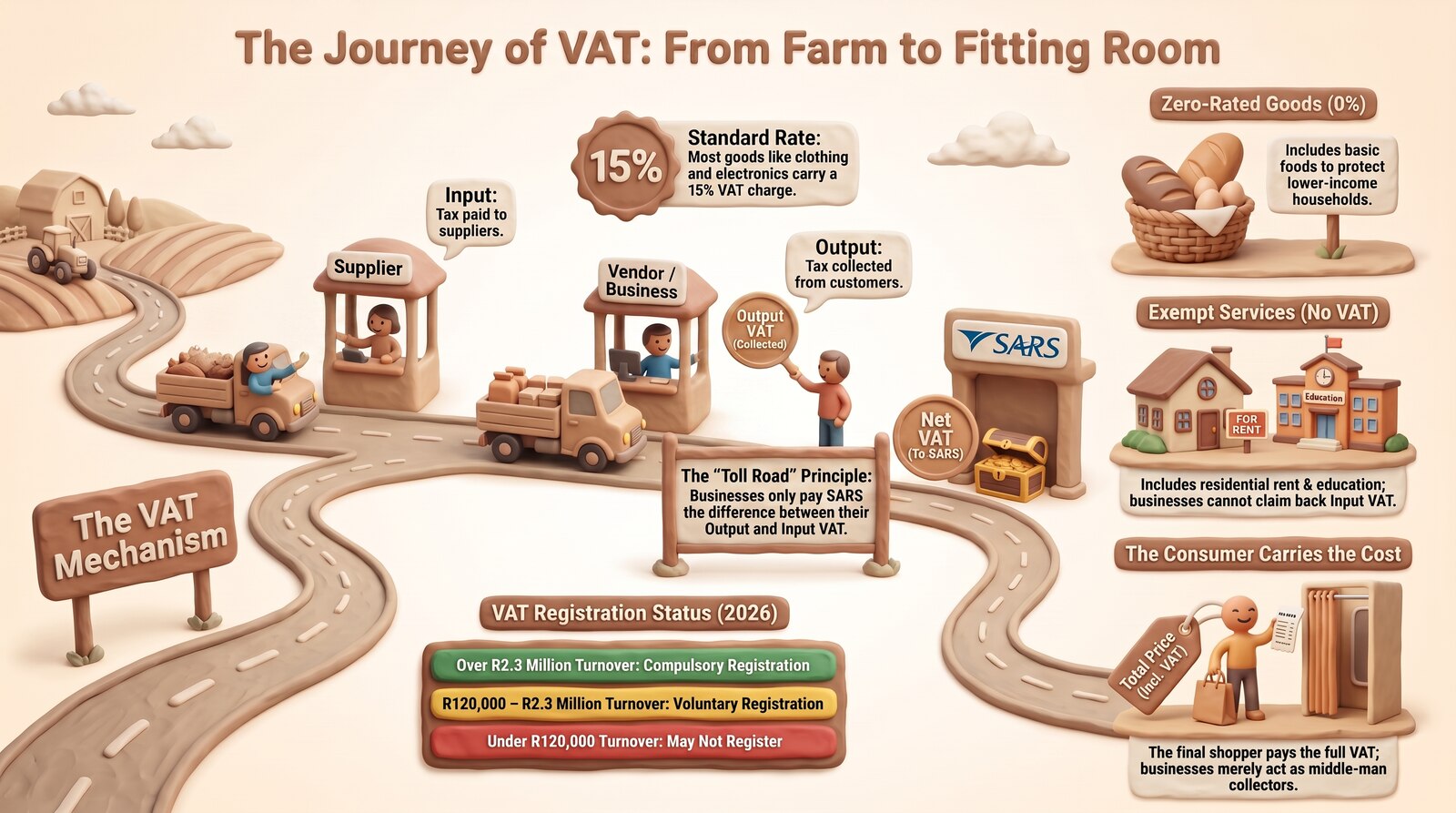
VAT is the topic more Grade 10 learners trip up on than almost any other — not because the maths is hard, but because it is usually taught as a list of rules. This summary tells it instead as a story: what actually happens to the money between the moment raw cotton is grown, and the moment a customer walks out wearing a finished T-shirt?
Direct tax vs indirect tax
Direct tax is taken straight from a person's or company's income (e.g. PAYE deducted from a salary) — the person who earns pays SARS directly.
Indirect tax is added onto the price of goods and services. The consumer never pays SARS directly — a business collects the tax on SARS's behalf and pays it over.
When you buy an item, you pay the shop. The shop — not you — is legally responsible for handing that VAT over to SARS. You never have any direct contact with SARS at all.
Picture a toll road with several toll gates. A product travels a similar kind of road — from raw material, to manufacturer, to shop, to your shopping bag. At each toll gate (each business), that business only pays a toll for the stretch of road IT travelled — the value IT personally added — never for the whole journey again.
✅ The Golden Rule
- No business in the chain is ever taxed on value that a PREVIOUS business already accounted for.
- Each business only ever pays SARS for the toll gate it personally owns.
- Nobody pays twice for the same piece of value.
| Term | Meaning | Direction |
|---|---|---|
| Output VAT | The VAT a business charges its OWN customers when it sells something | Money coming IN |
| Input VAT | The VAT the business itself pays to its OWN suppliers when it buys something | Money already paid OUT |
If Output VAT is BIGGER than Input VAT, the business pays the difference to SARS (the usual case). If Input VAT is BIGGER (e.g. after large equipment purchases), SARS refunds the difference to the business.
| Category | VAT rate | Input VAT claimable? | Examples |
|---|---|---|---|
| Standard-rated | 15% | Yes | Clothing, electronics, furniture, restaurant meals |
| Zero-rated | 0% | Yes | Brown bread, maize meal, milk, vegetables, eggs |
| Exempt | No VAT charged | No | School fees, residential rent, certain public transport |
To a shopper, BOTH look as though they carry "no VAT". But behind the scenes they are treated completely differently: a zero-rated vendor still charges VAT (just at 0%) and remains WITHIN the VAT system — it CAN claim back Input VAT. An exempt supplier stands COMPLETELY outside the system — it charges no VAT, BUT it also CANNOT claim back any Input VAT; it absorbs the cost itself.
| Method | When to use | Formula |
|---|---|---|
| Method 1 | Price INCLUDES VAT | VAT = Price (incl.) × 15/115 |
| Method 2 | Both prices (before and after VAT) given | VAT = Price (incl.) − Price (excl.) |
| Method 3 | Price EXCLUDES VAT | VAT = Price (excl.) × 15% |
"Included" in a question → use the ÷115 route or subtract. "Excluded" in a question → multiply by 15%. The words "including" and "excluding" are not decoration — they tell you exactly which method to use.
| Annual turnover | Registration status |
|---|---|
| More than R2.3 million | Compulsory registration — must register within 21 business days |
| Between R120,000 and R2.3 million | Voluntary registration — the business may choose |
| Less than R120,000 | May not register as a VAT vendor at all |
These thresholds increased sharply from 1 April 2026: the compulsory threshold rose from R1 million to R2.3 million, and the voluntary threshold rose from R50,000 to R120,000 — the first change in 17 years. A business registers by completing a VAT101 form, and usually submits a VAT return every two months.
Tax Avoidance (Legal)
Arranging your affairs, WITHIN the rules, to pay no more tax than necessary — e.g. by carefully timing a large purchase, or using legitimate deductions.
Tax Evasion (Illegal)
Deliberately hiding income, under-declaring sales, refusing to register when legally required, or falsifying records. A criminal offence with possible heavy penalties, backdated tax bills, and imprisonment.
Trendline's T-shirt travels through four VAT-registered businesses before it reaches Thabo, the final customer. Watch how VAT Payable at every stage equals exactly 15% of the value that business itself added.
| Business | Buys for (excl.) | Sells for (excl.) | Output VAT | Input VAT | VAT Payable |
|---|---|---|---|---|---|
| Karoo Cotton Farms | R0 (grows it) | R150.00 | R22.50 | R0.00 | R22.50 |
| Cape Textile Mills | R150.00 | R350.00 | R52.50 | R22.50 | R30.00 |
| Trendline Clothing Co | R350.00 | R600.00 | R90.00 | R52.50 | R37.50 |
| Fashion Hub (retail store) | R600.00 | R850.00 | R127.50 | R90.00 | R37.50 |
✅ The Insight This Table Proves
- Thabo, the final customer, pays R850.00 + R127.50 VAT = R977.50 in total.
- Add up the "VAT Payable" column: R22.50 + R30.00 + R37.50 + R37.50 = R127.50 — exactly the same as the Output VAT charged at the very last stage.
- SARS collects the same total amount either way — VAT simply spreads the collection across every business in the chain.
🖼️ Infographic
🖼️ Infographic
❓ Meervoudige Keusevrae
25 vrae • Geskommel elke keer❓ Multiple Choice Questions
25 questions • Shuffled every time📝 Vraebank
8 vrae • Modelantwoorde ingesluit📝 Question Bank
8 questions • Model answers included⚡ Flitskaarte
20 kaarte • Klik om om te draai⚡ Flashcards
20 cards • Click to flip📊 Gevallestudie
Namib Fietse • 35 punte oor 3 afdelingsNamib Fietse: 'n BTW-Gevallestudie
Namib Fietse is 'n geregistreerde BTW-verkoper wat fietse en fietsonderdele verkoop. In hierdie gevallestudie werk jy deur drie afdelings: die klassifisering van BTW-kategorieë, die berekening van Uitset- en Inset-BTW vir 'n volle maand, en die volg van 'n produk deur 'n volledige BTW-ketting.
📊 Case Study
Riverside Cycles • 35 marks across 3 sectionsRiverside Cycles: A VAT Case Study
Riverside Cycles is a registered VAT vendor that sells bicycles and bicycle parts. In this case study you work through three sections: classifying VAT categories, calculating Output and Input VAT for a full month, and tracing a product through a complete VAT chain.