📖 Kernbegrippe & Teorie
📖 Key Concepts & Theory
Onderwerp 7 bring alles wat jy tot dusver geleer het (Onderwerp 1-6) saam in EEN geïntegreerde vermoë. Jy moet nou, gegewe enige transaksie, self kan besluit watter joernaal dit hoort, dit boekstaaf, oorboek, en die hele siklus tot by die Proefbalans korrek uitvoer.
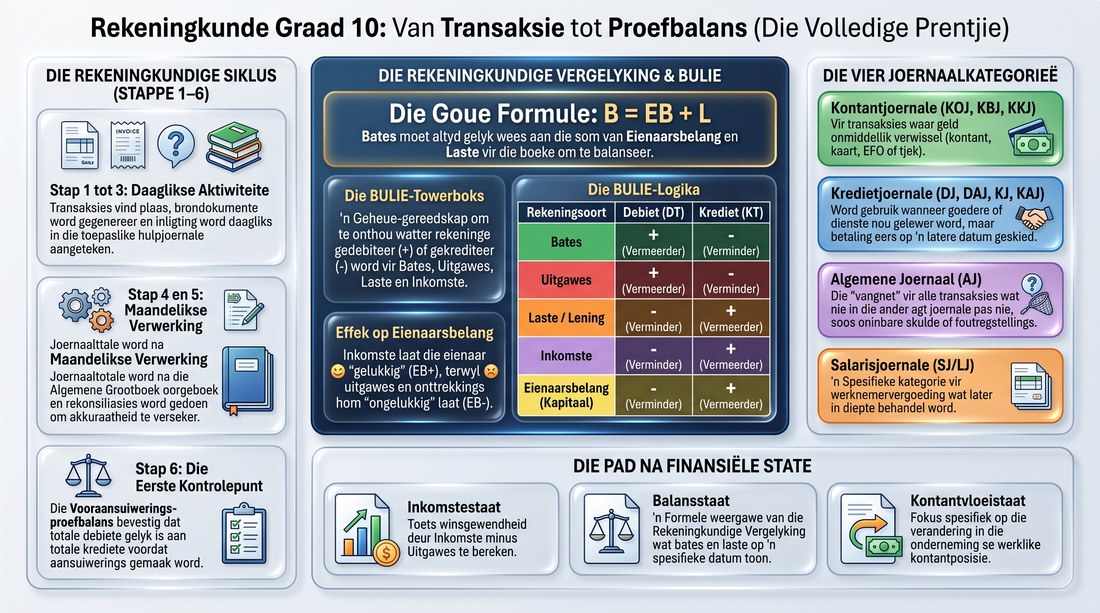
13 stappe in totaal — ons werk tot dusver tot by Stap 6 (die Proefbalans is die eerste kontrolepunt).
| # | Stap | Tempo |
|---|---|---|
| 1 | Transaksies | Daagliks |
| 2 | Brondokumente | Daagliks |
| 3 | Joernale | Daagliks |
| 4 | Algemene Grootboek | Maandeliks |
| 5 | Rekonsiliasies | Maandeliks |
| 6 | Vooraansuiwerings-proefbalans | Maandeliks — ONS EINDPUNT |
| Stappe 7-13 (Aansuiwerings tot Terugskrywings) volg later | ||
| Kategorie | Joernale | Wanneer gebruik |
|---|---|---|
| 1. Kontantjoernale | KOJ, KBJ, KKJ | Geld verwissel ONMIDDELLIK |
| 2. Kredietjoernale | DJ, DAJ, KJ, KAJ | Goedere nou, betaling LATER |
| 3. Salarisjoernale | SJ / LJ | Werknemervergoeding (Kwartaal 2) |
| 4. Algemene Joernaal | AJ | Die "vangnet" — pas in NIKS anders nie |
1) Terugbetaling/afslag? → DAJ/KAJ. 2) Geld dadelik? → KOJ/KBJ/KKJ. 3) Betaling uitgestel? → DJ/KJ. 4) Werknemervergoeding? → SJ/LJ. 5) Niks van bogenoemde? → AJ.
Algemene Grootboek vs Hulpgrootboeke
Die Algemene Grootboek bevat MAANDELIKSE TOTALE (Kontrolerekeninge). Die Hulpgrootboeke bevat DAAGLIKSE individuele besonderhede per debiteur/krediteur. Die Lys van Debiteure/Krediteure (uit Hulpgrootboeke) MOET met die Kontrolerekening (in die AG) ooreenstem.
Die Proefbalans
Bevestig dat totale Debiet = totale Krediet. Verdeel in twee afdelings: Balansstaatrekeninge (Bates, Laste, Eienaarsbelang — Folio begin met "B") en Nominale Rekeninge (Inkomste, Uitgawes — Folio begin met "N").
'n Gebalanseerde Proefbalans bewys SLEGS dat Debiet = Krediet — dit bewys NIE dat die boeke 100% korrek is nie. Foute soos volledige weglatings of kompenserende foute bly onsigbaar vir die Proefbalans.
| Staat | Wys... |
|---|---|
| Inkomstestaat | Inkomste- en Uitgawerekeninge (winsgewendheid) |
| Balansstaat | Bate-, Las- en Eienaarsbelangrekeninge op 'n spesifieke datum |
| Kontantvloeistaat | Verandering in kontantposisie oor die tydperk |
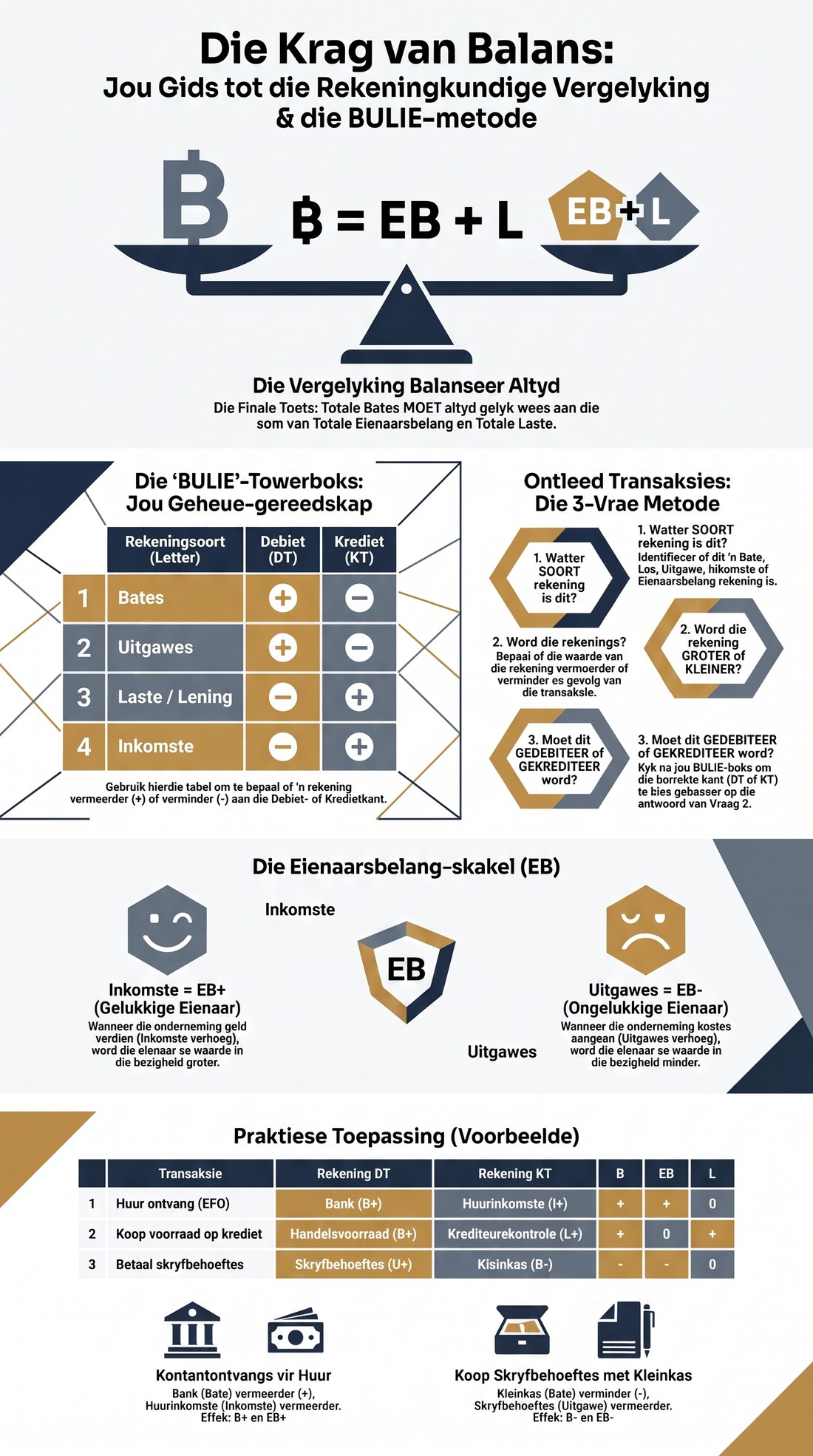
Die Balansstaat is presies die Rekeningkundige Vergelyking (B = EB + L) in 'n formele formaat: Totale Bates MOET altyd gelyk wees aan Totale Eienaarsbelang plus Totale Laste.
Bate
Iets wat die onderneming BESIT. Nie-bedryfsbates (langer as 'n jaar, bv. Grond en Geboue) en Bedryfsbates (verander gedurig, bv. Voorraad, Debiteure, Bank).
Las
Geld wat die onderneming SKULD. Nie-bedryfslaste (nie binne 12 maande terugbetaal nie, bv. Lening) en Bedryfslaste (binne 12 maande, bv. Krediteure, Oortrokke Bank).
Eienaarsbelang
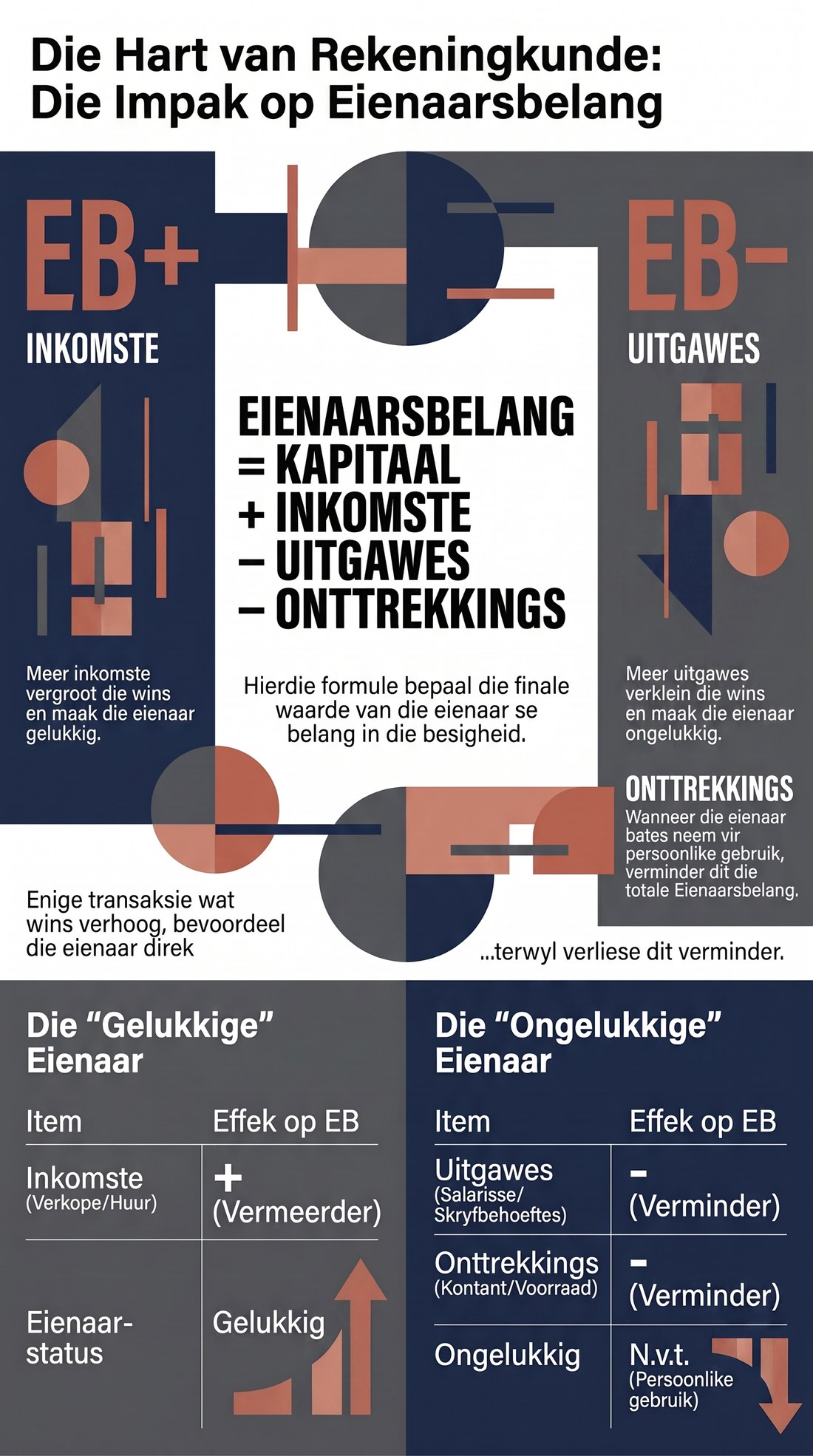
Eienaarsbelang = Kapitaal + Netto Wins vir die Jaar − Onttrekkings. Eienaar en onderneming word as APARTE ekonomiese entiteite behandel.
'n Uitgawe-rekening VERMEERDER aan die Debietkant (BULIE) — MAAR die EFFEK op Eienaarsbelang is steeds NEGATIEF, want 'n uitgawe verklein die wins. Debiet/Krediet-plasing en effek-op-Eienaarsbelang is TWEE APARTE vrae.
| Letter | Rekeningsoort | Debiet | Krediet |
|---|---|---|---|
| B | Bates | + (verhoog) | − (verlaag) |
| U | Uitgawes | + (verhoog) | − (verlaag) |
| L | Laste | − (verlaag) | + (verhoog) |
| I | Inkomste | − (verlaag) | + (verhoog) |
Kontroleer ALTYD dat jou antwoord een van nege patrone is: (+,+,0) (+,0,+) (−,−,0) (−,0,−) (0,+,−) (0,−,+) (0,0,0) (+/−,0,0) (0,+/−,0). Linkerkant MOET altyd gelyk wees aan Regterkant.
✅ Stapsgewyse Metode — Drie Vrae per Rekening
- 1) Watter SOORT rekening is dit? (B? L? U? I? EB?)
- 2) Word dit GROTER of KLEINER?
- 3) Moet dit GEDEBITEER of GEKREDITEER word? (BULIE-boks)
- As Inkomste/Uitgawes geraak word: sal die eienaar GELUKKIG (EB+) of ONGELUKKIG (EB−) wees?
Topic 7 brings everything you've learned so far (Topics 1-6) together into ONE integrated ability. Given any transaction, you must now be able to decide which journal it belongs in, journalise it, post it, and carry the full cycle through to the Trial Balance correctly.
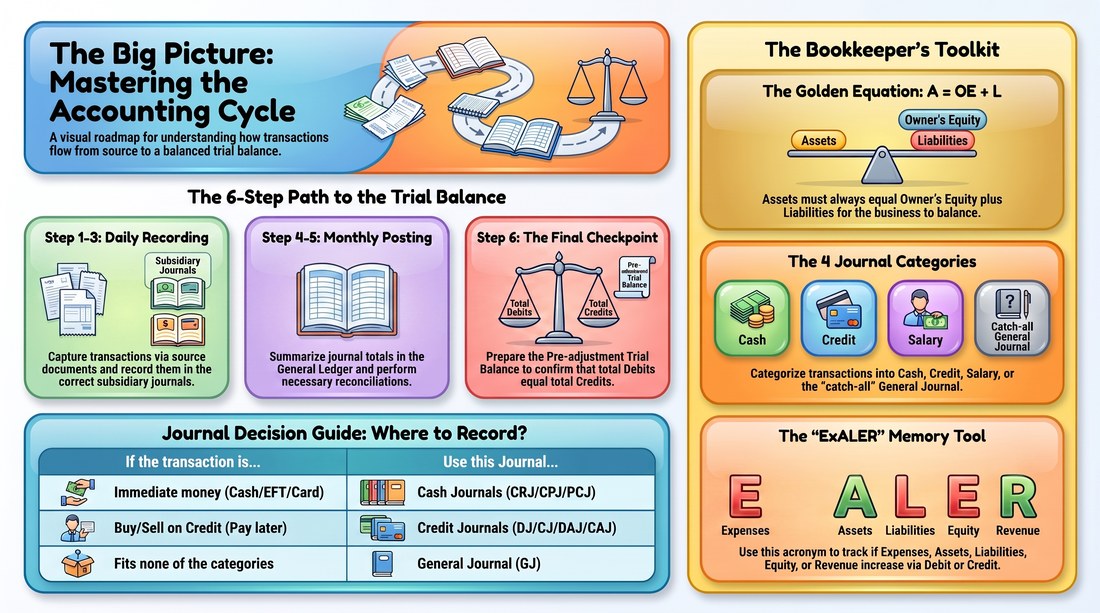
13 steps in total — we work up to Step 6 so far (the Trial Balance is the first checkpoint).
| # | Step | Pace |
|---|---|---|
| 1 | Transactions | Daily |
| 2 | Source Documents | Daily |
| 3 | Journals | Daily |
| 4 | General Ledger | Monthly |
| 5 | Reconciliations | Monthly |
| 6 | Pre-adjustment Trial Balance | Monthly — OUR ENDPOINT |
| Steps 7-13 (Adjustments to Reversing entries) follow later | ||
| Category | Journals | When used |
|---|---|---|
| 1. Cash journals | CRJ, CPJ, PCJ | Money changes hands IMMEDIATELY |
| 2. Credit journals | DJ, DAJ, CJ, CAJ | Goods now, payment LATER |
| 3. Salary journals | SJ / WJ | Employee compensation (Quarter 2) |
| 4. General Journal | GJ | The "catch-all" — fits NOTHING else |
1) Return/allowance? → DAJ/CAJ. 2) Immediate money? → CRJ/CPJ/PCJ. 3) Deferred payment? → DJ/CJ. 4) Employee compensation? → SJ/WJ. 5) None of the above? → GJ.
General Ledger vs Subsidiary Ledgers
The General Ledger contains MONTHLY TOTALS (Control Accounts). The Subsidiary Ledgers contain DAILY individual details per debtor/creditor. The List of Debtors/Creditors (from Subsidiary Ledgers) MUST match the Control Account (in the GL).
The Trial Balance
Confirms total Debit = total Credit. Divided into two sections: Balance Sheet Accounts (Assets, Liabilities, Owner's Equity — Folio begins with "B") and Nominal Accounts (Income, Expenses — Folio begins with "N").
A balanced Trial Balance proves ONLY that Debit = Credit — it does NOT prove the books are 100% correct. Errors such as complete omissions or compensating errors remain invisible to the Trial Balance.
| Statement | Shows... |
|---|---|
| Income Statement | Income and Expense accounts (profitability) |
| Balance Sheet | Asset, Liability and Owner's Equity accounts on a specific date |
| Cash Flow Statement | Change in cash position over the period |
The Balance Sheet is exactly the Accounting Equation (A = OE + L) in a formal format: Total Assets MUST always equal Total Owner's Equity plus Total Liabilities.
Assets
Something the business OWNS. Non-current Assets (longer than a year, e.g. Land and Buildings) and Current Assets (change constantly, e.g. Inventory, Debtors, Bank).
Liabilities
Money the business OWES. Non-current Liabilities (not repaid within 12 months, e.g. Loan) and Current Liabilities (within 12 months, e.g. Creditors, Bank Overdraft).
Owner's Equity
Owner's Equity = Capital + Net Profit for the Year − Drawings. Owner and business are treated as SEPARATE economic entities.
An Expense account INCREASES on the Debit side (ExALER) — BUT the EFFECT on Owner's Equity is still NEGATIVE, because an expense shrinks profit. Debit/Credit placement and effect-on-Owner's-Equity are TWO SEPARATE questions.
| Letter(s) | Account Type | Debit | Credit |
|---|---|---|---|
| Ex | Expenses | + (increase) | − (decrease) |
| A | Assets | + (increase) | − (decrease) |
| L | Liabilities | − (decrease) | + (increase) |
| E | Equity | − (decrease) | + (increase) |
| R | Revenue | − (decrease) | + (increase) |
Always check your answer is one of nine patterns: (+,+,0) (+,0,+) (−,−,0) (−,0,−) (0,+,−) (0,−,+) (0,0,0) (+/−,0,0) (0,+/−,0). Left-hand side MUST always equal Right-hand side.
✅ Step-by-Step Method — Three Questions per Account
- 1) What TYPE of account is it? (A? L? Ex? R? OE?)
- 2) Does it get BIGGER or SMALLER?
- 3) Must it be DEBITED or CREDITED? (ExALER box)
- If Income/Expenses are affected: will the owner be HAPPY (OE+) or UNHAPPY (OE−)?
🖼️ Infographic
🖼️ Infographic
More infographics coming soon
Additional English infographics for this topic will be added soon.
❓ Meervoudige Keusevrae
40 vrae • Geskommel elke keer❓ Multiple Choice Questions
40 questions • Shuffled every time📝 Vraebank
15 vrae • Modelantwoorde ingesluit📝 Question Bank
15 questions • Model answers included⚡ Flitskaarte
15 kaarte • Klik om om te draai⚡ Flashcards
15 cards • Click to flip📊 Gevallestudie
Gevallestudie kom binnekort
Laai die materiaal op en ek bou die scenario en vrae uit.
📊 Case Study
Case study coming soon
Upload the material and I will build the scenario and questions.